Book of Words: Skeleton’s Key by Stacy Green

I’m using this blog to offer a chance at building a better vocabulary through the books I read. I’ll provide a short review of the book followed by a few words I think the author used in an interesting way or that might not be familiar, at least to me. In this case, I included “antebellum” because the definition states that it can be used for the period before any war, and I found that interesting. I’m only familiar with it being used before the American Civil War.

Photo from the Facebook page of Stacy Green. She attributed the photo to Melinda VanLone, author.

Photo from the Facebook page of Stacy Green. Green attributed the graphic to Melinda VanLone, author, who created it for Green’s Delta Crossroads Trilogy.

Skeleton’s Key (Delta Crossroads Trilogy, Book 2) by Stacy Green

I thoroughly enjoyed reading Skeleton’s Key and just picked up two more books by Stacy Green. She’s a fantastic storyteller. I love the characters and felt their pain, tension and thrills as they struggled to sort out the complexities of the puzzles of murder and the history of an antebellum home. The book’s plot reminded me a little of the Nancy Drew mystery, The Hidden Staircase, one of my very favorite books when I was much younger. Saying that, I must add that there’s no doubt that Skeleton’s Key is for mature readers. It kept me guessing throughout and surprised me with a twist in the end. Her Delta Crossroads Trilogy is fantastic, but this author is quite prolific. I intend to check out more of her work!

Words from Skeleton’s Key:

Warded: Any of the internal ridges or bars in a lock that prevent the turning of any key that does not have the grooves of corresponding size or form.
“Dani again examined the locking mechanism. ‘It’s warded.’ ‘Meaning a skeleton Key probably opens it.’”

Spanish moss: A flowering plant that often grows upon larger trees, commonly the southern live oak and bald-cypress in the lowlands and savannas of southeastern United States. It’s also native in much of Mexico, Bermuda, the Bahamas, Central America, South America and the West Indies. It grows hanging from tree branches in full sun through partial shade.
“At night, under the silvery glow of the moon, the wisps of Spanish moss were ghostlike-the spirits of the past weaving their way through the twisted branches of the tree.”

Daguerreotype: A photograph taken by an early photographic process employing an iodine-sensitized silvered plate and mercury vapor.
“Hard to tell with the state of the picture, and the fact that it’s a daguerreotype further distorts the color.”

Antebellum: Occurring or existing before a particular war, esp. the American Civil War: the conventions of the antebellum South. The origin is Latin, from ante ‘before,’ and bellum ‘war.’
“After the dust settled, Jaymee inherited one of the town’s other flagship antebellum homes, Magnolia House.”

Definitions are typically from The New Oxford American Dictionary through Kindle, or from Wikipedia.

“The difference between the almost right word and the right word is… the difference between the lightning bug and the lightning.” — Mark Twain

Do you look up words as you read?

Book of Words: Lamb to the Slaughter

I’m using this blog to offer an opportunity to build a better vocabulary through the books I read. I’ll provide a short review of the book followed by a few words I think the author used in an interesting way or that might not be familiar, at least to me.

Lamb to the Slaughter (Book 1 of Serentity’s Plain Secrets) by Karen Ann Hopkins

Lamb to the Slaughter takes the reader into the Amish community through the eyes of a newly elected female sheriff. It’s a well written story of murder, religious prejudice and poisonous pride. It’s the first book by Hopkins featuring Sheriff Serenity Adams that’s a great start on a series of mysteries with an intriguing protagonist and a glimpse into a different way of life. So far, the author has published four Plain Secrets books with the latest released in May. I’m ready to read book 2, Whispers From the Dead and find out what’s next for Sheriff Adams.

img_2535

Words from Lamb to the Slaughter:

Rumspringa: (in some Amish communities) a period of adolescents in which boys and girls are given greater personal freedom and allowed to form romantic relationships, usually ending with the choice of baptism into the church or leaving the community.
“You see, we don’t practice rumspringa in our community. If a teenager has wild oats to sow, they typically leave.”

Dolt: A stupid person. The origin may be a variant of dulled.
“You already know that our community has the rule of hands-off courting, but I’m not a dolt. I know what goes on behind the barns and in the sheds.”

Nitrile: An organic compound containing a cyanide group bound to an alkyl group. They’re not latex, but stronger and allergy safe.
“He left for a minute and returned with nitrile gloves, which he held out.”

Pensive: Engage in, involving or reflecting deep or serious thought.
“Bobby had a pensive frown fixed on his face again when I said, ‘Maybe with the abundance of corn available, the smaller scavengers weren’t interested.’”

Piqued: A feeling of irritation or resentment resulting from a slight, especially to one’s pride.
My curiosity was piqued and I looked at Heather.”

The last two in this list, pensive and piqued, are words I know but rarely use. Any words you hear or read often but rarely use?

“The difference between the almost right word and the right word is… the difference between the lightning bug and the lightning.” — Mark Twain

Definitions are typically from The New Oxford American Dictionary through Kindle.

Every Word is a Choice and Opportunity

“The difference between the almost right word and the right word is… the difference between the lightning bug and the lightning.” — Mark Twain

As a newspaper reporter, I was taught to write at an 8th grade level. Editors stressed that wasn’t literal. It meant we should avoid using words that force the reader to seek out a dictionary to understand the meaning. I try to do the same in my writing.
As a reader, however, I love to come across a word that isn’t familiar or is used in a way I find intriguing. Words and how they are used are interesting to me, and even at this age in life, I love to learn something new and maybe something about myself along the way.
In this blog, I plan to take a few words from the books I read and share the fun.
I’ll offer a short review, tell you a little about the book, and then provide a few words the author used in an interesting way or might not be familiar, a least to me. You’ll see the definition and how it was used in the book.

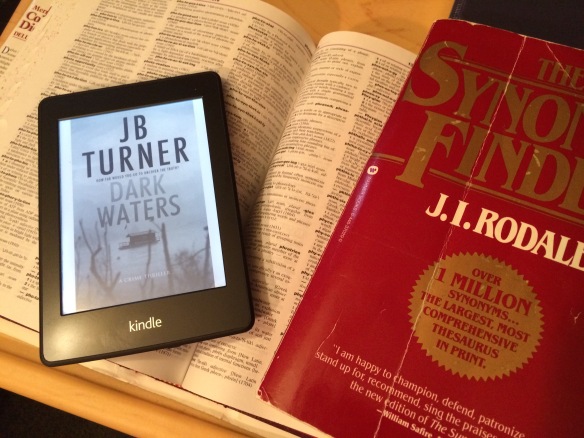
Dark Waters by JB Turner
This book had a little more of a spy-thriller theme than I normally read, but I enjoyed the read. It’s about an investigative reporter (which is right up my alley) in the Florida Everglades investigating the murder of a young man who’d contacted her the day before wanting to provide her with some top-secret government documents. The reporter, Deborah Jones, has her own life and the life of her longtime boyfriend and editor threatened as she fights to discover the truth. She soon realizes the implications of the investigation run deep in national politics. Deep Waters is a real thriller from the first page to the end.

img_2517Deep Waters words:

Bonhomie: cheerful friendliness; geniality.
“It reminded him of the Middle America he loathed. Bowling shoes, customized bowling ball, the beer, the head-splitting music, and the fake bonhomie.”

Detritus: waste or debris of any kind.
“All around was the detritus of humankind, playing out their days in air-conditioned malls, like consumer battery farms, being force-fed a sludge of sugar-rush drink and chili dogs, and copious quantities of piss-poor Bud and Michelob.”

Tacitly: an adjective that means understood or implied without being stated.
“From these Islamic schools a wave of young Muslim men emerged who, tacitly backed by CIA dollars, were organized to fight first the Soviet Union — before they turned their attention to the West.”

Wahhabism: Wahhabi is a strictly orthodox Sunni Muslim sect that advocates a return to the early Islam of the Koran and Sunna, rejecting later innovations. It’s the predominant religious force in Saudi Arabia.
“She had remained single but, like the majority of people in Saudi Arabia, she adhered to Wahhabism, the strict theological interpretation of the Koran.”

Stygian: an adjective of or relating to the Styx River.
“He stared at the Stygian darkness of Biscayne, car lights moving slowly across the causeway.”

What interesting words have you come across lately?