T. J. Klune offers up a story of magic and strife against prejudice in The House in the Cerulean Sea. Yet there’s something even deeper in a theme about living a worthwhile life. This quote from early in the book summed up that thought:
“It does me no good. Facts., Mr. Parnassus. I deal in facts. Curiosities lead to flights of fancy, and I can’t afford to be distracted.”
“I can’t imagine a life lived in such a way,” Mr. Parnassus said quietly. “It sounds like no life lived at all.”
In this blog I offer a different type of book review—one that’s combined with vocabulary building. In The House in the Cerulean Sea I found a number of words that had me curious about their use or meaning.
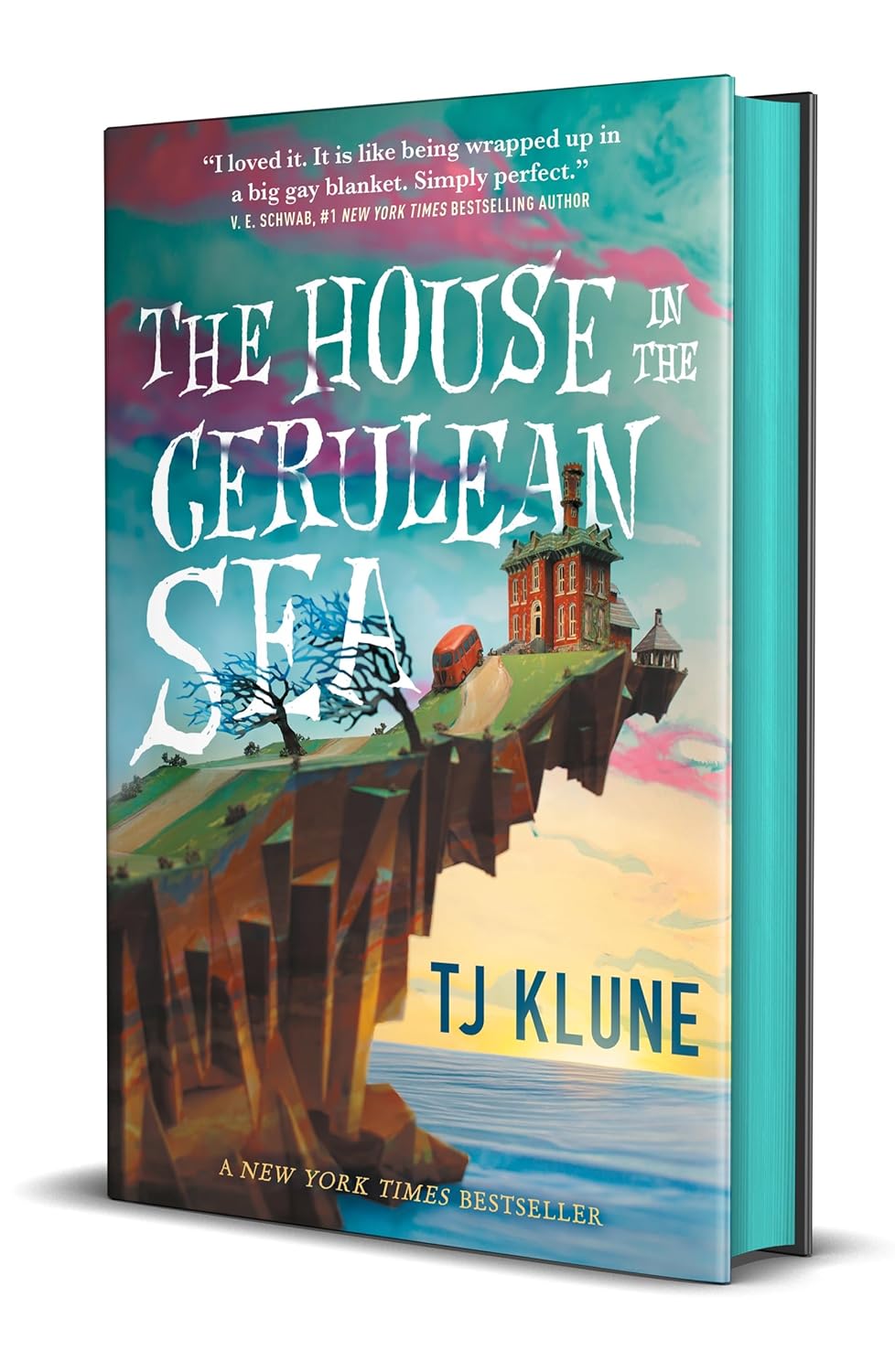
From The House in the Cerulean Sea:
He pointed toward a copse of trees just off the beach. It looked dark and foreboding.
They eventually made their way to familiar ground, and in the distance Linus could see a copse of trees that hid the house of an island sprite.
copse: noun, a small group of trees
—
From The House in the Cerulean Sea:
That and the fact he’d recently turned forty, and all he had to show for it was a tiny house, a crusty cat that would probably outlive everyone, and an every-expanding waistline his doctor had poked and prodded with a strange amount of glee while bloviating about the wonders of dieting.
bloviate: verb (no object) U.S. English informal – talk at length, especially in an inflated or empty way
—
From The House in the Cerulean Sea:
The woman’s hair was cut into a petite bob, and she wore a large brooch in the shape of a beetle, the carapace iridescent.
carapace: noun, the hard upper shell of a turtle, crustacean, or arachnid / something regarded as a protective or defensive covering
—
From The House in the Cerulean Sea:
The air was thick and redolent, and it made him slightly dizzy.
redolent: adjective 1. (redolent of/with) strongly reminiscent or suggestive of / literary – strongly smelling of 2. archaic, or literary – fragrant or sweet-smelling
—
From The House in the Cerulean Sea:
His aquiline nose had a bump in the center, as if it’d been broken once long ago and never set right.
aquiline: adjective, hooked, curved, hook-shaped, hooklike, bent, bowed, angular
—
From The House in the Cerulean Sea:
There was always a note of artifice to their bright words of happiness and joy and No, Mr. baker, absolutely nothing is wrong, and I am filled with joy.
artifice: adjective, making a strong, affected, or pretentious display of being artistic or interested in the arts
—
From The House in the Cerulean Sea:
At dinner, Lucy had been grinning at Linus the whole time, and though it had the same devilish tinge to it, Linus didn’t think it was nefarious.
nefarious: adjective, (typically of an action or activity) wicked or criminal
—
From The House in the Cerulean Sea:
His luggage was beside him. Calliope too, in her crate, though she wasn’t amused at the early hour. Linus could commiserate, especially since he hadn’t slept a wink.
commiserate: verb, express or feel sympathy or pity; sympathize
—
From The House in the Cerulean Sea:
Arthur sighed. “Not—not physically. But he’s an expert in self-flagellation after. If something is broken, no matter who it belongs to , he always carries the guilt upon his shoulders.”
self-flagellation: noun, the action of flogging oneself, especially as a form of religious discipline / excessive criticism of oneself
—
What interesting words or terms have you found in your recent reading?
—
To connect or learn more about T. J. Klune and his books, check out his website at tjklunebooks.com.
—
Definitions are typically from the dictionary that comes with my Mac or The New Oxford American Dictionary.
—
“The word is only a representation of the meaning; even at its best, writing almost always falls short of full meaning. Given that, why in God’s name would you want to make things worse by choosing a word which is only cousin to the one you really wanted to use?” ― Stephen King, On Writing: A Memoir of the Craft
 Lori Ericson