Haig’s Christmas Series Offers Holiday Fun for Young Readers

Featured

The Girl Who Saved Christmas is an absolute fun read for the holidays and would be a great Christmas gift for a younger reader. I’d seen the film adaptation of Matt Haig’s A Boy Called Christmas last year and spotted this gem at the library while looking for middle-grade fiction. I want to read Father Christmas sometime in the coming weeks. I’m sure it’s just as delightful. The stories are full of adventure and Christmas magic. (Side note: I’ve written a middle-grade Christmas book myself that’s set to publish in 2026.)

In this blog I offer a different type of book review­—one that’s combined with vocabulary building. Included here, are a few interesting words I found in The Girl Who Saved Christmas by Matt Haig.
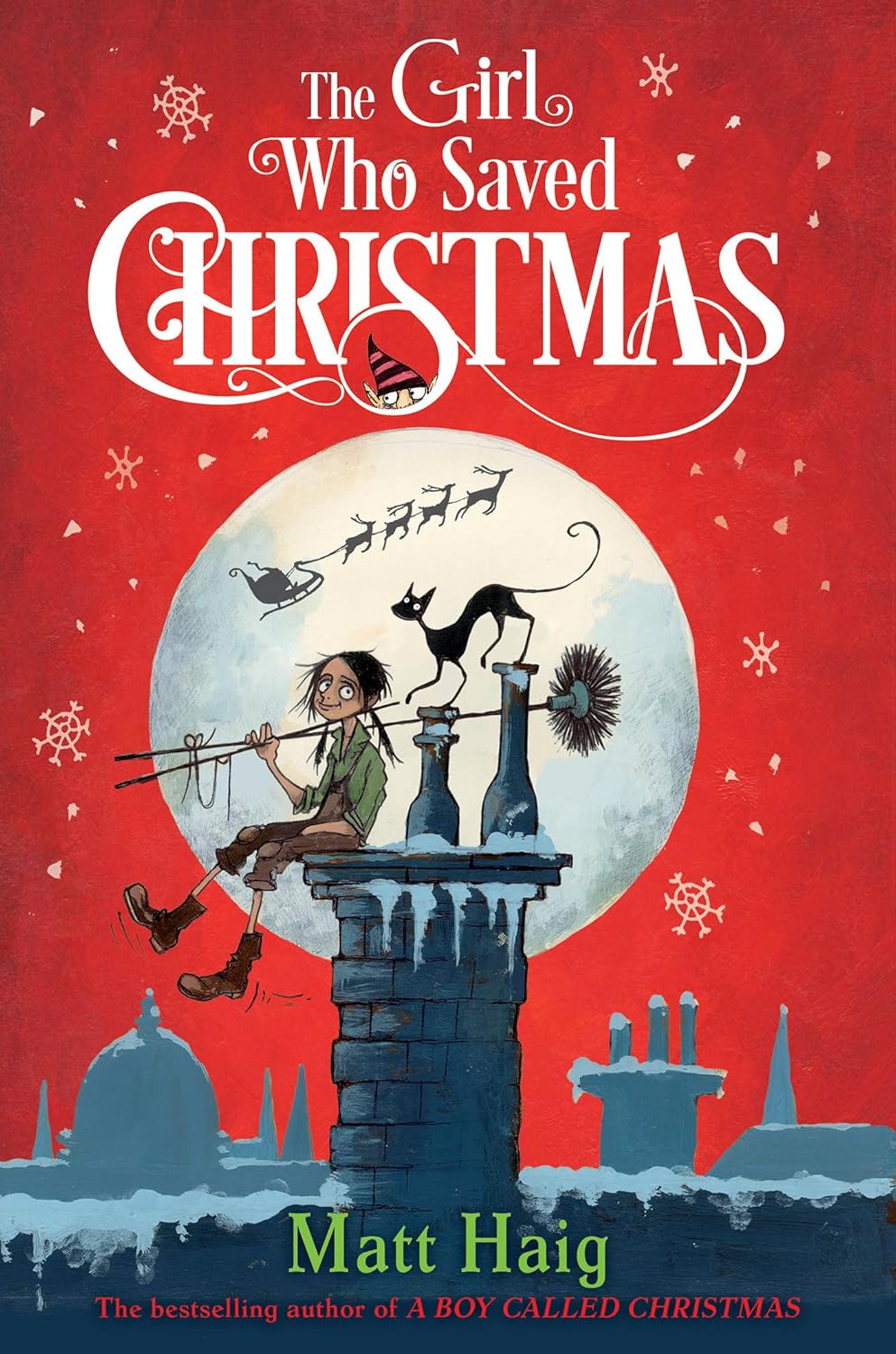
These particular words are not unfamiliar in meaning but are important to the book and appropriate for the coming holiday season:

possibility: noun. a thing that may happen or be the case; the state or fact of being likely or possible; likelihood; a thing that may be chosen or done out of several possible alternatives; unspecified qualities of a promising nature; potential.

From The Girl Who Saved Christmas

“She was the one who had hoped the most that first-ever Christmas. The one who had put enough magic in the air simply by believing in it. And that was before any child in the world had known about Father Christmas. She had believed. Not in him. But in possibility. In the kind of possibility that could mean something like delivering toys to every child on earth could actually happen.”

magic: noun. the power of apparently influencing the course of events by using mysterious or supernatural forces; mysterious tricks, such as making things disappear and appear again, performed as entertainment; a quality that makes something seem removed from everyday life, especially in a way that gives delight. — adjective. used in magic or working magic; having or apparently having supernatural powers. — verb. move, change, or create by or as if by magic.

From The Girl Who Saved Christmas

“I was so happy that Christmas, opening those presents. So, so, so happy. Not because of the presents, but because of the magic that had brought them there. To know magic exists.”

time: noun. 1. the indefinite continued progress of existence and events in the past, present, and future regarded as a whole. 2. a point of time as measured in hours and minutes past midnight or noon. 3. time as allotted, available, or used. 4. An instance of something happening or being done; an occasion. 5. (times) (following a number) expressing multiplication. 6. The rhythmic patter of a piece of music, as expressed by a time signature. — verb. 1. plan, schedule, or arrange when (something) should happen or be done. 2. measure the time taken by (a process, activity, etc., or a person doing it).

From The Girl Who Saved Christmas

“She closed her eyes and thought of time. If only she could go back in time to be with her mother again. Or forward to when she could leave this place.”

 Definitions are typically from the dictionary that comes with my Mac or The New Oxford American Dictionary.

“The word is only a representation of the meaning; even at its best, writing almost always falls short of full meaning. Given that, why in God’s name would you want to make things worse by choosing a word which is only cousin to the one you really wanted to use?”

Stephen King, On Writing: A Memoir of the Craft.

A VOCABULARY BOOK REVIEW: ONE TRUE LOVES

Featured

One True Loves caught my devoted interest in the first chapter. That’s when Emma Blair’s husband, lost at sea in a helicopter crash years before, calls just as she’s finishing up a family dinner with her financé. The plot enfolds two love stories and Emma must make a choice, her forever choice. Author Taylor Jenkins Reid yanks a rope around your heart and keeps it restrained between the pages in this beautifully written tale that could have no better ending.

In addition to One True Loves, published in 2016, Reid has a number of titles under her belt including Daisy Jones &The Six, now a miniseries on Prime video. Visit her website at TaylorJenkinsReid.com for more information. 

In this blog, I offer a different type of book review — one that’s combined with vocabulary building. Included here are a few interesting words I found in One True Loves, written by Taylor Jenkins Reid and published by Washington Square Press, an imprint of Simon & Schuster.

The definitions here are for just a few words from One True Loves that I found interesting, unfamiliar, or unusual in use:

hooligan: noun. (perhaps from Patrick Hooligan—Irish hoodlum in Southwark, London 1898) Ruffian, hoodlum. 

From One True Loves

“To them, I had gone from a precious little girl to a hooligan overnight.”

conciliatory: adjective. 1. a. not flowing in a current or stream (stagnant water) b. Stale 2. Not advancing or developing. 

From One True Loves

“’I’m going to give Eli a conciliatory hug and then, Olive, we can head home,’ she said.”

gamine: noun. (French feminine of gamin) 1. A girl who hangs around on the streets. 2. A small playfully mischievous girl. adjective Of, relating to, or suggesting a gamine.   

From One True Loves

“The only change she can see is my short, blond hair.

‘It’s very gamine.’”

assuage: verb. 1. To lessen the intensity of (something that pains or distresses): ease. 2. Pacify, quiet. 3. To put an end to by satisfying: appease, quench.  

From One True Loves

“It was gestures like that, small acts of intimacy between them, that made me think my parents probably still had sex. I was both repulsed and somewhat assuaged by the thought.”

stagnant: adjective. 1. a. not flowing in a current or stream (stagnant water) b. Stale 2. Not advancing or developing. 

From One True Loves

“People aren’t stagnant. We evolve in reaction to our pleasures and pains.”

 Definitions are typically from the dictionary that comes with my Mac or Merriam Webster.

“The word is only a representation of the meaning; even at its best, writing almost always falls short of full meaning. Given that, why in God’s name would you want to make things worse by choosing a word which is only cousin to the one you really wanted to use?” ― Stephen KingOn Writing: A Memoir of the Craft.

Bride Swap — A Romance by Author Beth Carter

Featured

In this blog, I offer a different type of book review — one that’s combined with vocabulary building. Included here are a few interesting words I found in Bride Swap.

Bride Swap is a fun romantic read. Author Beth Carter provides a heartfelt tale of two female characters each struggling to make it on their own, one with a child to support. You’ll have to pick up a copy of Bride Swap to see who’s getting married or not.

The definitions below are for just a few words important for the telling of this absolutely adorable love story:

engaged: adj1. Busy; occupied. BRIT. (of a telephone line) unavailable because already in use. 2. Having formally agreed to marry. 3. (architecture) (of a column) attached to or partly let into a wall. 

From Bride Swap:

“She glanced at her bare ring finger. She was newly engaged but hadn’t yet told anyone at the station. She knew how some of her more cut-throat colleagues would be once they heard she was set to marry the top anchor at the rival television station across town.”

swag: noun. 1. An ornamental festoon of flowers, fruit, and greenery. 2. INFORMAL money or goods taken by a thief or burglar. 3. AUSTRAL/NZ a traveler’s or miner’s bundle of personal belongings. 

Slang definitions include: 1. Term for advertising merchandise, branded merchandise, or promotional products. 2. Formerly used for anything cool. 

From Bride Swap:

“Emma, you’re more creative than me, plus you make all of that beautiful swag for authors. You’re amazing with that stuff. I’d love for you to plan a gorgeous wedding for Trent and me.”

transfixed/transfix: verb. 1. Cause someone to become motionless with horror, wonder, or astonishment. 2. Pierce with a sharp implement or weapon.

From Bride Swap

“He stood transfixed as if he were a marble statue. The smirk Paige had seen one too many times appeared as Trent asked, ‘Did someone have a bad day? Is it that time of month, Paige, or is Zach-y boy going after your job like I knew he would?’”

 Definitions are typically from the dictionary that comes with my Mac or The New Oxford American Dictionary.

“The word is only a representation of the meaning; even at its best, writing almost always falls short of full meaning. Given that, why in God’s name would you want to make things worse by choosing a word which is only cousin to the one you really wanted to use?” ― Stephen KingOn Writing: A Memoir of the Craft.

Interview by Author David Todd

I’ve known of David Todd as an engineer who works for a local firm I deal with a lot as city planner. We met recently at a panel discussion his firm hosted and realized we were not only fellow authors but Facebook friends. He’s been super supportive of the release of A Lovely Murder, the second Danni “Deadline” Thriller, and offered to interview me on his blog. Thanks, David, for the support!

Here’s a link to my interview by Author David Todd on his webpage:

Author Interview: Lori Ericson

meposter

Book of Words: Wilde Lake by Laura Lippman

“The difference between the almost right word and the right word is… the difference between the lightning bug and the lightning.” — Mark Twain

This blog offers a different type of book review­—one that’s combined with vocabulary building. The words chosen may be familiar, but used in a unique way or not commonplace.

Included here, following a short review, are a few interesting words I found in Wilde Lake, a book released earlier this year by author Laura Lippman. Lippman, a best-selling author and absolutely superb storyteller, is one of my very favorite writers.

Wilde Lake is the story of a family, a family full of secrets. It’s also a tale about prejudice and how we may try to deny its existence but cannot truly shed the ingrained natuimg_2597re of it in our society, and in turn, ourselves. Lippman’s skill at pulling multiple tentacles of a story together thrives in this tale, but she eloquently succeeds at something unique even for her. The story is told from the perspective of one character, but some of it comes to us in the first-person account of a remembered childhood, while the rest is told in third-person present tense as all those story tentacles come together for Lu Brant, a newly elected state’s attorney. The combination of first and third person from the same protagonist is so competently handled that I didn’t catch it until well into the book. It seems to bring a more intimate view into the life unfolding in Wilde Lake. The unique characterization provides a deeper grasp of what is happening in Lu Brant’s life as she digs into her own family history while sorting out the facts of her first capital murder case in her new position. The layers of revelations and connections to Brant’s past keep the pages turning. From the book jacket: “If there is such a thing as the whole truth, Lu realizes—possibly too late—that she would be better off not knowing what it is.”

Words from Wilde Lake:

Suborn: v. bribe or otherwise induce (someone) to commit an unlawful act such as perjury. “They might have been led during the interviews. But I don’t think my father suborned perjury, not over so trivial a thing.”

 Ascetic: adj. characterized by or suggesting the practice of severe self-discipline and abstention from all forms of indulgence, typically for religious reasons. “AJ stands, walks to the edge of his pool. A lap pool, he defended to Lu when she mocked this expense by ascetic.” AND “He then made his own Eat, Pray, Love pilgrimage around the world, although ascetic AJ skipped the eating part.”

 Canard: n. an unfounded rumor or story. “Everyone knows the old canard that an attorney never asks a question to which she doesn’t know the answer, but that’s for court, after investigations, depositions, discovery.”

 Polemics: n. a strong verbal or written attack on someone or something. “’No,’ he says adamantly. ‘No more polemics disguised as memoirs.’”

 Ersatz: adj. (of a product) made or used as a substitute, typically an inferior one, for something else. “Heck, her father has had an ersatz wife in Teensy all these years.”

 Imprecation: n. a spoken curse. “The EMT guys decide to let her go home, although with muttered imprecations about concussions, and while Lu scoffs at them, she finds herself unaccountably nervous as bedtime nears.”

 Perambulate: v. walk or travel through or around (a place or area), esp. for pleasure and in a leisurely way. “’Your house? No, I just­—I just sometimes like to . . . perambulate,’ Davey said.”

 Frisson: n. a sudden strong feeling of excitement or fear; a thrill. “Lu feels a strange frisson of nerves when she goes before the grand jury to obtain a formal indictment against Rudy Drysdale.”

 Nascent: adj. (esp. of a process or organization) just coming into existence and beginning to display signs of future potential. “I wish he had saved his nascent memoir. I would have loved to read his version of his life, then and now.”

 Scrim: n. strong, coarse fabric, chiefly used for heavy-duty lining or upholstery. “As the song reached its climax, a scrim depicting the Tree of Life fell and somehow it seemed as if the chorus had become a living, breathing Tree of Life.”

Pejorative: adj. expressing contempt or disapproval, or n. a word expressing contempt or disapproval. “The original ‘villages’ of Columbia are now called the ‘inner villages,’ and the pejorative echo of inner city is not accidental.”

 Dilettante: n. a person who cultivates an area of interest, such as the arts, without real commitment or knowledge. “During the campaign, Fred called her a dilettante, tried to suggest that she wanted his job so she wouldn’t be bored.”

Definitions are typically from The New Oxford American Dictionary.

What interesting words have you taken note of lately? What do you do when you come across an unfamiliar word while reading?

New Baby Arrives!

Two boxes of books arrived today, and I couldn’t be more excited and proud. A Lovely County was published in January last year. A Lovely Murder, the second in the Danni Deadline Thriller Series is out this week.

img_2583

I’m hosting a book launch this Sunday, November 13, at the Fayetteville Public Library, Fayetteville, AR, from 2 to 4 p.m. to make it official. If you’re in driving range, please come.

I want to share this moment because the thrill of publication is just as strong as the first time. It’s kind of like having a baby and then the baby’s sibling. I love both books. I love the nurturing of each word to create my babies. And I love the stories still floating as embryos in my head yearning for birth.

One thing that stays strong with me is the gratitude I feel for my publisher, Pen-L Publishing. They are the VERY best! Duke and Kim Pennell have held my hand from the first pitch of my story to this past week when lining out what my bookmarks will look like. They are supportive and diligent, allowing me to have the last word on the cover and most everything, all the while providing the best in editing and professional help through the process. On top of all that, they are nearly as excited as I am to see this baby arrive.

So, come if you can on Sunday. Hear me read a little from the book, pick up a copy of my new baby, and have a cookie and punch to celebrate!

If you can’t come, check it out on Amazon or on from my publisher, Pen-L at http://www.Pen-L.com/ALovelyMurder.html.

Book of Words: Intrusion by Mary McCluskey

Good writers choose their words carefully. This blog offers a different type of book review by combining it with vocabulary building. Included here are a few interesting words I found in Intrusion, a book released in July by British author Mary McCluskey. Some of the words McCluskey used were British and unfamiliar to me, so I included them in this blog.

Intrusion pits a woman who has hit rock bottom against a long-lost best friend with a hidden motive. Mary McCluskey deftly pulls the reader into the emotional turmoil of Kat Hamilton’s shattered life. The mourning mom struggles to support her husband’s efforts to maintain his standing in his law firm and fights to find meaning in her own life, but can barely get through each day. When she’s at her lowest, evil steps in to help push her over the edge. I found Intrusion to be an exciting psychological thriller that kept the tension high while ever increasing the stakes all the way to an end with a unexpected twist. McCluskey knows how to keep the reader guessing.

Cover pdf provided by Author Mary McCluskey

Cover pdf provided by Author Mary McCluskey

Words from Intrusion:

Cabochon: A gem polished but not faceted. <Origin> mid-16th century: from French, diminutive of caboche ‘head’. “Sara gave a small smile and looked down, twisting the cabochon emerald ring off her finger, then holding it for a few seconds, as if checking its weight, before replacing it.”

 Sepia: A reddish-brown color associated particularly with monochrome photographs of the 19th and early 20th centuries. <Special Usage> a brown pigment prepared from a black fluid secreted by cuttlefish, used in monochrome drawing and in watercolors. “These memories dropped softly, completely intact, into her mind. Sometimes, they were in strong, primary colors, occasionally in a kind of sepia, like old movies.”

Intransigent: Unwilling or refusing to change one’s views or to agree about something. “He is a lawyer. He has the nitpicky legal mind. I never dreamt he would be so intransigent.”

Janus: An ancient Italian deity, guardian of doorways and gates and protector of the state in time of war. He is usually represented with two faces, so that he looks both forward and backward. <Special Usage> two-faced; hypocritical; two-sided. “In profile, the two sides of her face could look quite different: one side so bare, the delicate bone structure clear and unobstructed, the other side hidden by a cascade of rich brown hair. A Janus face, Maggie had said once.”

 Sussed: (Chiefly British, informal) A verb meaning to realize, grasp. An abbreviation of suspect or suspicion. “Though Sister Judy may have sussed me.”

 Gobsmacked: (Chiefly British, informal) Utterly astonished; astounded. <Origin> 1980s: from GOB + SMACK, with reference to being shocked by a blow to the mouth, or to clapping a hand to one’s mouth in astonishment. “They’ll all be gobsmacked.”

Definitions are from The New Oxford American Dictionary through Kindle.


“The word is only a representation of the meaning; even at its best, writing almost always falls short of full meaning. Given that, why in God’s name would you want to make things worse by choosing a word which is only cousin to the one you really wanted to use?” ― Stephen King

What interesting words have you taken note of lately?

Book of Words: EXHUME by Danielle Girard

“The most important thing is to read as much as you can, like I did. It will give you an understanding of what makes good writing and it will enlarge your vocabulary.”

— J.K. Rowling

I’m using this blog to offer a chance at building a better vocabulary through the books I read. I’ll provide a short review of the book followed by a few words I think the author used in an interesting way or that might not be familiar, at least to me.

14481926_1130665450334830_876338458951004379_o

Exhume (Dr. Schwartzman Series, Book 1) by Danielle Girard

I really enjoyed this thriller and had a hard time putting my Kindle aside until the end. The protagonist, Dr. Annabelle Schwartzman, is very well written by Girard. I found myself feeling it all as the young medical examiner works to solve the murder of a woman who could be her twin. She soon realizes the killer chose the victim for that very reason. As the plot thickens and the threats mount against her, Schwartzman gains strength rather than cowering in the knowledge that her own life is in danger. I found the story gripping. Girard is an excellent writer. Check her out at daniellegirard@com.

This book, because of its medical examiner character, offered a number of unfamiliar words.

Words from Exhume:

Manubrium: The broad upper part of the sternum of mammals, with which the clavicles and first ribs articulate.  “She fingered the place where her necklace always lay flat against her manubrium.”

Parasympathetic: (adj.) of or relating to the part of the automatic nervous system that counterbalances the action of the sympathetic nerves. It consists of nerves arising from the brain and the lower end of the spinal cord and supplying the internal organs, blood vessels and glands.  “Her parasympathetic nervous system now back in control, her empty stomach ached, leaving her nauseous and exhausted.”

 Hemangioma: A benign tumor of blood vessels, often forming a red birthmark.  “Behind Stein’s right knee was another birthmark, this one a hemangioma. The hemangioma—sometimes called a raspberry—was the result of blood vessels that clustered in utero and never fully dissipated.”

 Aquiline: (adj.) Like an eagle. Special usage: (of a person’s nose) hooked or curved like an eagle’s beak.  “Plenty who were tall and thin as she was, even some with an aquiline nose like her own and others who had been born with a nose like hers and then had the hump surgically removed.”

 Whorls: A coil or ring, in particular: a complete circle in a fingerprint.  “’I’ve seen documented cases where they’ve pulled whorls off flesh.’ ‘Whorls?’ T.J. asked. ‘From fingerprints,” Harper explained.”

 Clinodractyly: A medical term describing the curvature of a digit (a finger or toe) in the plane of the palm, most commonly the fifth or little finger towards the adjacent fourth finger or ring finger.  “Her long, lean fingers, fingers like her father’s had been, like her own, their tips curved in just slightly, making them appear slightly arthritic. The clinical term was clinodactyly, a condition that caused a curvature of the digits, though theirs was mild enough to go unnoticed unless one knew to look.”

 Alveoli: A small cavity, pit, or hollow, in particular: any of the many tiny air sacs in the lungs where the exchange of oxygen and carbon dioxide takes place. “Oxygen flowed into the bronchi, then into the smaller bronchioles and into the alveoli. Two adult lungs were the home to some three hundred million alveoli where the oxygen dissolved into the moisture-rich covering of the alveoli and diffused into the blood.”

Definitions are typically from The New Oxford American Dictionary through Kindle or Wikipedia.

What interesting words have you taken note of lately?

Book of Words: Skeleton’s Key by Stacy Green

I’m using this blog to offer a chance at building a better vocabulary through the books I read. I’ll provide a short review of the book followed by a few words I think the author used in an interesting way or that might not be familiar, at least to me. In this case, I included “antebellum” because the definition states that it can be used for the period before any war, and I found that interesting. I’m only familiar with it being used before the American Civil War.

Photo from the Facebook page of Stacy Green. She attributed the photo to Melinda VanLone, author.

Photo from the Facebook page of Stacy Green. Green attributed the graphic to Melinda VanLone, author, who created it for Green’s Delta Crossroads Trilogy.

Skeleton’s Key (Delta Crossroads Trilogy, Book 2) by Stacy Green

I thoroughly enjoyed reading Skeleton’s Key and just picked up two more books by Stacy Green. She’s a fantastic storyteller. I love the characters and felt their pain, tension and thrills as they struggled to sort out the complexities of the puzzles of murder and the history of an antebellum home. The book’s plot reminded me a little of the Nancy Drew mystery, The Hidden Staircase, one of my very favorite books when I was much younger. Saying that, I must add that there’s no doubt that Skeleton’s Key is for mature readers. It kept me guessing throughout and surprised me with a twist in the end. Her Delta Crossroads Trilogy is fantastic, but this author is quite prolific. I intend to check out more of her work!

Words from Skeleton’s Key:

Warded: Any of the internal ridges or bars in a lock that prevent the turning of any key that does not have the grooves of corresponding size or form.
“Dani again examined the locking mechanism. ‘It’s warded.’ ‘Meaning a skeleton Key probably opens it.’”

Spanish moss: A flowering plant that often grows upon larger trees, commonly the southern live oak and bald-cypress in the lowlands and savannas of southeastern United States. It’s also native in much of Mexico, Bermuda, the Bahamas, Central America, South America and the West Indies. It grows hanging from tree branches in full sun through partial shade.
“At night, under the silvery glow of the moon, the wisps of Spanish moss were ghostlike-the spirits of the past weaving their way through the twisted branches of the tree.”

Daguerreotype: A photograph taken by an early photographic process employing an iodine-sensitized silvered plate and mercury vapor.
“Hard to tell with the state of the picture, and the fact that it’s a daguerreotype further distorts the color.”

Antebellum: Occurring or existing before a particular war, esp. the American Civil War: the conventions of the antebellum South. The origin is Latin, from ante ‘before,’ and bellum ‘war.’
“After the dust settled, Jaymee inherited one of the town’s other flagship antebellum homes, Magnolia House.”

Definitions are typically from The New Oxford American Dictionary through Kindle, or from Wikipedia.

“The difference between the almost right word and the right word is… the difference between the lightning bug and the lightning.” — Mark Twain

Do you look up words as you read?

Publishing Choice is Personal

It’s a tough world in publishing these days. How do you decide which way to turn? Hold out for the big publishing contract that will likely never happen and doesn’t have the advantages it once did? Self publish and do all the work yourself?

The idea of self publishing is a viable consideration, but there’s something about the credibility that comes with signing with a publisher. Not to mention that a publisher takes care of working out a cover, formatting, etc. etc. etc.! Small indie publishers can offer so much to a new author these days that big publishing houses don’t. Namely, individual attention and a bigger percentage in royalties.

I published my first book with a small indie publisher. I’m proud of the effort I put into that first book, and the outcome.

Kimberly and Duke Pennell of Pen-L Publishing offered me a contract for three upcoming novels. My response, "Where's my pen? Then, a big THANK YOU!"

Kimberly and Duke Pennell of Pen-L Publishing offered me a contract for three upcoming novels. My response, “Where’s my pen? Then, a big THANK YOU!”

I recently signed with a different indie publisher based in Arkansas for my future books. I’m so excited that they were interested in my writing. Duke and Kimberly Pennell, who formed Pen-L Publishing just a couple of years ago, already have 75 or so titles under their belt. I opted to sign on with them mainly because of the integrity so evident in the two of them, but also because of their love of the craft and their dedication to creating a good product.

The choice was very personal to me. My writing is my heart. What I create with my voice is a part of me. I want to know that I can trust and feel proud of my choice in a publisher.

In November, Pen-L will publish A Lovely Murder, sequel to my first novel A Lovely County. I’m proud to say that A Lovely Murder took The President’s Award and 1st Place in the Unpublished Manuscript contest at Ozark Writers League late last year, so I can’t wait to see it in print.

Pen-L also graciously contracted to publish two more of my novels next year. A Lovely Grave is the third in the mystery series about small-town reporter Danni Edens. A fourth novel has yet to be titled.